The fall doesn’t end with a splash. It ends with mud.
Thick, freezing, foul-smelling mud shoving its way up my nose and into my open mouth.
I gag, violently expelling a mouthful of water that tastes like ancient silt and rotting algae. It doesn’t taste like the Sumida River. The city runoff flavor, gasoline and the industrial waste, is completely absent.
I push myself up onto my hands and knees. The mud sucks loudly at my boots.
I’m blind. The absolute pitch-black of the tunnel I fell through has been replaced by a heavy, oppressive fog that diffuses what little ambient light exists into a dull, flat gray. My slitted eyes dilate to their maximum limit, struggling to pull in data.
I wait for the noise. I brace my ears against my skull, fully expecting the overlapping, high-speed screams of the dead to start hammering my brain again. The drowned university student should be right next to me, gloating about the temperature of the water. The communist from the apartment should be screaming about his chest cavity.
Nothing.
I blink. I twitch my left ear. I twitch the right one.
Silence.
It’s not just quiet. It’s a total, suffocating vacuum of supernatural noise. The incessant ninety-miles-an-hour radio broadcast of misery has been unplugged. The inside of my head belongs entirely to me for the first time since I woke up.
I let out a shaky breath. The air pressure here is wrong. It’s heavier, sitting on my chest like a wet wool blanket.
Basic deduction. I jumped off a bridge in the middle of Tokyo. Terminal velocity for a fifty-kilo mass dropping twenty feet means I should have hit the water in about 1.1 seconds. I fell for much longer than that. And the river beneath Ryogoku Bridge does not have mud banks this wide or air this stagnant.
The drowned student told me to jump. He called it a fast way out.
I didn’t hit the river. I hit the geographic course the suicide victims take. A dimensional off-ramp. A localized tear in the physical world where the heavy, bloated things wash up when the city is done with them.
The Yokai realm.
I try to stand up. My legs refuse to cooperate.
The muscles in my thighs simply fail to fire. It’s not simply fatigue, it’s a complete systemic shutdown. My glucose reserves are totally depleted. My liver has exhausted its glycogen stores. The engine driving this freakish bipedal body is starving, and if I don’t input calories immediately, it’s going to start cannibalizing its own muscle tissue to keep my brain functioning.
I collapse back into the mud.
My left arm throbs. The sleeve of my coat is shredded from ripping the hardened spider silk off, and the skin underneath is scraped raw, weeping clear plasma into the dirt.
My right hand is locked in a rictus grip. I look down.
I’m still holding the damn CIA attaché case. The leather handle is practically fused to my palm by rigor. It’s a miracle the fall didn’t snap my wrist. I slowly peel my fingers open, one by one. The joints pop in protest. I drop the heavy case into the mud.
I need food. I need a source of heat. I need to not die in a supernatural ditch after surviving a giant spider and a pack of demon dogs.
A sound drifts through the fog.
It’s a wailing, tragic melody, completely off-key, cracking on the high notes. Someone is singing. Extremely badly.
Then, the smell hits me.
It cuts through the rotting algae and the silt. Cheap tobacco. Burning paper. Toasted leaves.
Tobacco means fire. Fire means people. Or at least, things that use fire like people.
I grab the handle of the attaché case again, using it like a crutch. Driving the hard corner of the box into the mud to drag myself forward. I crawl up the embankment, my boots slipping and sliding in the muck. My tails drag uselessly behind me, caked in heavy wet clay.
The fog thins out as I crest the ridge.
It’s a massive floodplain. Rusted detritus litters the muddy ground. Old tires, waterlogged crates, a corroded bicycle frame.
Sitting in the middle of this garbage dump, gathered around a crackling fire burning inside a rusted oil drum, are four men.
Except they aren’t men.
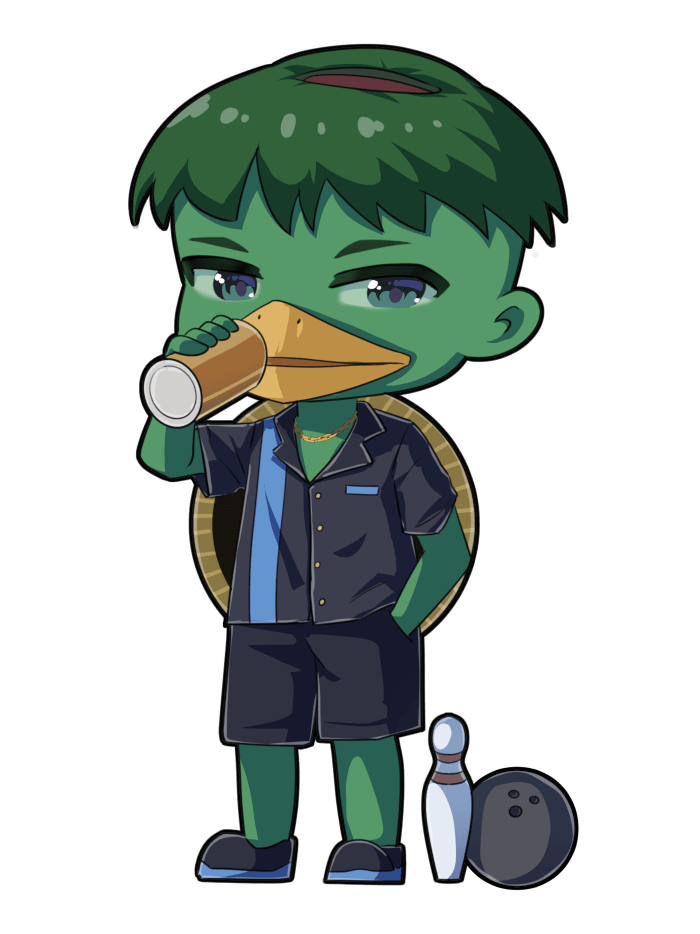
They are squat, human-shaped things with greenish, rubbery skin. They have wide, bug-like eyes that reflect the firelight and heavy, duck-like bills instead of mouths. I can see the webbing between their thick fingers as they pass a bottle around. Heavy, turtle-like shells sit hunched on their backs.
The most bizarre detail is the tops of their heads. They are completely bald in the center, forming a shallow, bowl-like depression that holds a small puddle of stagnant water.
Kappa. Water demons. I don’t know much about yokai but everyone knows kappa, oni and tengu.
I stare at them from the mud. They don’t look majestic. They don’t look terrifying. They look like a group of middle-aged men who just finalized messy divorces and decided to live next to a river since their ex-wife got the house.
Their clothes are tragic. The one currently butchering the enka song is wearing a stained bowling shirt that is two sizes too small, the fabric stretching dangerously over his shell. The biggest one, a massive wall of muscle and green fat sitting quietly on a rusted milk crate, is wearing high-water slacks held up by suspenders. Another one, looking entirely dopey and staring blankly into the fire, is picking his teeth with a splinter of wood.
The leader is sitting on a discarded car seat. He has a hand-rolled cigarette clamped in the corner of his duck bill. He’s shuffling a deck of water-damaged playing cards with surprising dexterity. He’s not wearing a placard proclaiming I’m The Leader or anything. It’s just clear from his posture, and the way the others interact with him, that he has more say than they do.
I try to take a step forward. My boot catches on a submerged root. I stumble, dropping the attaché case, and crash face-first into a pile of dry reeds just at the edge of the firelight.
The awful singing stops instantly. Four sets of massive, bulbous eyes snap toward me.
The silence that follows is heavy. The only sound is the crackle of the fire in the oil drum and my own ragged breathing. I push myself up onto my elbows. The mud coats the front of my shirt and cakes my blonde hair. My cat ears are pinned flat against my skull in exhaustion.
The Kappa just stare.
They must know what I am. The physical traits are obvious.
The dopey one with the splinter drops it out of his mouth.
“What’s she doing here,” the singer whispered.
“They don’t come down here” the muscular one said flatly.
“Shh,” the kappa in the car seat continued to shuffled his cards with a frown. “Cat girly can hear you.”
The massive one on the milk crate doesn’t move, but his posture goes rigid. He sets his beer bottle down on the dirt.
Do they know who I am? They know what I am. Or as much of it as I’ve been able to piece together. If the yokai in the Ueno alleys could smell the American stink on me, these four definitely can. Whatever I’ve been doing since my transformation, it makes them look at me like I’m a live grenade. I’m radioactive.
I remember the legends of the kappa suddenly. Crop thieves. They sometimes drowned people for fun. And sometimes with women they would… I stepped backwards slowly.
I wait for them to pull weapons. I wait for them to yell at me to leave, just like the yokai did. I don’t have the energy to fight them. If they rush me, I’m going to die right here in the reeds.
The leader on the car seat stops shuffling the cards. He takes a long, slow drag from his cigarette. The cherry burns bright orange. He exhales a thick cloud of blue smoke through his nostrils, letting it drift up over the puddle of water on his head.
He doesn’t reach for a weapon. He doesn’t look panicked. He looks shrewd. His eyes quickly track over my ruined coat, the bleeding scrapes on my arm, the way my knees are visibly shaking under my own weight, and finally, the heavy leather briefcase lying in the mud. I can’t tell what he’s thinking but he seems almost pleased.
He taps his deck of cards on his knee, leveling a perfectly calm, entirely dismissive look at me.
“Well, well,” he says. His voice is a raspy croak that sounds like a badly damaged engine. “Look what washed down the drain.”
He leans forward to get a better look at me and offers a wide, duck-billed smile that contains absolutely no warmth.
“You lost, cutie pie?”
“Lost implies I had a destination,” I say. My own voice sounds like sandpaper on rusted iron.
The leader chuckles. It sounds like a bullfrog getting stepped on. “Right. Well. You look like hell, no offense.”
“I’ve had a busy night.” I try to push myself up. My left arm shakes so violently I collapse back onto my elbows. The mud squelches.
“You don’t say.” The leader takes another drag of his cigarette. “Name’s Shōkichi. This miserable lot,” he gestures vaguely with his cards to the other three, “is the crew. Dochi, Enkō and Gatarō. We mind our business down here. Usually.”
“Usually.”
“Usually, cat girlies don’t come falling out of the sky looking like they went ten rounds with a meat grinder,” Shōkichi says. He taps the ash from his cigarette onto the wet ground. “So let me guess. You’re in a bad spot. You need a hole to hide in. I happen to have a vacant flat down the way. Four walls. A ceiling. A door that locks.”
A lock. The word hits my brain like a shot of adrenaline. But could I trust them? There were four of them here right now. I deducted that if they had bad intentions they would have acted already. My fatigue was heavier than my doubts.
“What’s the catch?” I ask.
“No catch. Just a favor.” He shuffles the cards again. The paper walls are so waterlogged I don’t know how they don’t disintegrate. “We’re fixing up our bowling alley. We need lumber. Two-by-fours, plywood, some nails. The hardware shop up the street has a full yard out back, but they’re so darn expensive.”
I stare at him. I literally cannot compute the absurdity of the request. My brain is still trying to process a dead communist and a carnivorous spider-woman. And this bug-eyed water demon wants me to help him steal wood for a bowling alley.
“You want me to rob a hardware store.”
“Distract,” Shōkichi corrects, pointing a webbed finger at me. “You walk in the front. You make a scene. Ask for a hammer, complain about the price, knock over a display. Whatever. We load the truck out back. Ten minutes tops. You do that, the flat is yours.”
I run the math. If I hit the front door and throw a heavy object, say, a cast-iron wrench, through a glass display case, the resulting acoustic shockwave and shatter pattern will immediately draw the proprietor’s attention and trigger a stress response. Ten minutes is six hundred seconds. That’s a long time to sustain a distraction without getting the authorities called.
But it’s doable.
I have no money. I have no allies. If I sleep in this mud, I will probably freeze to death or get eaten by whatever else washes down that dimensional drainpipe.
I really need a door with a lock.
“Fine,” I say. “Deal.”
Shōkichi grins, showing off a row of flat, blunt teeth. “Excellent. We move tomorrow night.”
I don’t reply. I just stare at the fire. More specifically, I stare at the rusted metal grate sitting over the oil drum. Four whole river fish are roasting on it, their skin blistering and bubbling in the heat. Next to the drum sits a wooden crate half-full of pale green cucumbers.
My stomach cramps so hard I fold entirely in half.
I push myself up into a seated position. The mud clings to my ruined coat. I drag the heavy CIA attaché case closer to my knee, using it as an armrest.
“Can I sit with you?” I ask.
The question hangs in the heavy, foggy air.
The dopey one, Dochi, drops his splinter again. The singer, Enkō, stares at me like I just grew a third ear. Shōkichi’s cigarette hangs loosely from his beak, completely forgotten.
Why are they staring? My mind is running in loops driven by a sugar low. “I’m starving,” I say, blunt and exhausted. “I need food. Please.” I really don’t understand their body language but I understand the pain in my belly and it is loud.
Shōkichi looks at the massive Kappa sitting on the milk crate with a single raised eyebrow.
Gatarō hasn’t moved. He’s built like a brick wall painted green. He stares at me with heavy, unblinking black eyes. He looks at the way my hands shake. He looks at my flattened ears. He evaluates the absolute lack of hostility in my posture.
Gatarō reaches into the wooden crate and pulls out a cucumber. He snaps it perfectly in half with one massive, webbed hand, then tosses half to me.
I catch it instinctively. I don’t even bother wiping the mud off my fingers. I just bite into it.
The crunch is loud in my own skull. The rush of water and simple sugars hits my tongue, and my brain instantly screams for more. I devour the entire half in three bites. I almost choke on the seeds.
“Slow down, cutie pie,” Shōkichi says. He sounds less cautious now. More amused. He reaches over the fire, grabs one of the sticks holding a roasted fish, and holds it out.
“Eat the bones. Good for calcium.”
I take the stick. The fish is charred black on one side and barely cooked on the other. A Maillard reaction gone horribly wrong. It smells heavily of swamp weed and iodine. I tear into it anyway.
The sudden caloric payload drops into my shrunken gut like a cinderblock. My liver finally gets the fuel it needs to start converting glycogen. The violent trembling in my left arm slowly begins to subside.
I sit in the mud, chewing on a burnt river fish, surrounded by four amphibious deadbeats. It’s quiet. Enkō doesn’t sing. Shōkichi deals a hand of solitaire on the ground in front of him. Dochi watches the fire.
I finish the fish. I eat the bones just like he said. They crunch satisfyingly between my teeth. I eat another cucumber. The metabolic fire in my gut banks down from a roaring panic to a dull, manageable ache.
“Thanks,” I mutter, tossing the wooden stick into the oil drum.
Gatarō nods once.
Shōkichi smiles back at him. He reaches into his pocket. He pulls out a brass key tied to a piece of dirty string and tosses it to me. I catch it against my chest.
“Building three. Second floor. Number four,” Shōkichi says, pointing a thumb over his shoulder into the fog. “Don’t break anything.”
“I won’t.”
I grab the attaché case. It feels five pounds lighter now that I actually have some calories in my system. I push myself up to my feet. My knees hold.
I turn and walk in the direction he pointed.
The floodplain eventually gives way to a sprawling, dilapidated shantytown. The structures are a mess of rusted shipping containers, scavenged timber, and concrete blocks slapped together without any regard for building codes. It looks like a slum built out of shipwrecks.
Building three is a concrete block structure with a corrugated tin roof. I climb the exterior metal stairs. They groan under my weight. I can see why they need lumber out here. I step lightly.
Second floor. Number four.
The door is cheap plywood, delaminating at the bottom due to prolonged moisture exposure. I slide the brass key into the lock. A simple pin-tumbler mechanism. It turns with a heavy, rusted clank.
I push the door open.
The flat is a single room. It’s maybe ten feet by ten feet. There is no furniture. No bed. No chair. Just a bare, scuffed wooden floor and a single dirty window looking out over the fog. The air smells like old dust and dry rot.
It may be the most beautiful thing I have ever seen.
I step inside, shut the door and slide the deadbolt home. The heavy metal click is the most comforting sound I’ve heard all night.
I drop the attaché case on the floor and it hits the wood with a dull thud. I don’t bother taking off my boots. I don’t take off the shredded, mud-caked coat. I just put my back against the wall next to the door and slide down until my rear hits the floorboards.
I pull my knees to my chest. My tails wrap around my ankles automatically. Built-in ankle warmers.
I’m not quite ready to relax yet. I keep my ears open, listening hard for ghosts. I wait for the high-speed murmurs. The terrible, magnetic pressure of the mysterious voice on the phone pulling at the base of my skull.
None of it comes. The silence holds.
The Yokai realm is a damp, dirty slum. But right now, it’s a haven.
I close my eyes. The exhaustion finally wins, dragging me down into a heavy, dreamless dark.


Leave a Reply