Okay, first up, WHAT IS THIS?!
A former Deutsche Bank compliance officer told the FBI she was fired in 2018 after flagging suspicious activity in accounts linked to Jeffrey Epstein and Jared Kushner, offering yet another example of how they operated above the law:
Oh wait, we know what it is. A MOSSAD op doing what a MOSSAD op does.
Oh you think I’m kidding?
New Epstein records trigger tensions between Netanyahu and Barak amid Mossad claims
Fresh attention on Jeffrey Epstein has triggered strong reactions in Israel after newly released documents highlighted his past interactions with former Israeli Prime Minister Ehud Barak. The documents, which include emails and financial records, have reignited online speculation that Epstein may have had links to Israel’s intelligence agency, Mossad.
LIBERALS…
“Russia, Russia, Russia” is not how to pronouse “Israel, Israel, Israel.”
Epstein was put here to control the American government through pedophelia. Which brings me back to the British museum…
Read: British Museum removes the word ‘Palestine’ from displays following pressure by pro-Israel lawyers
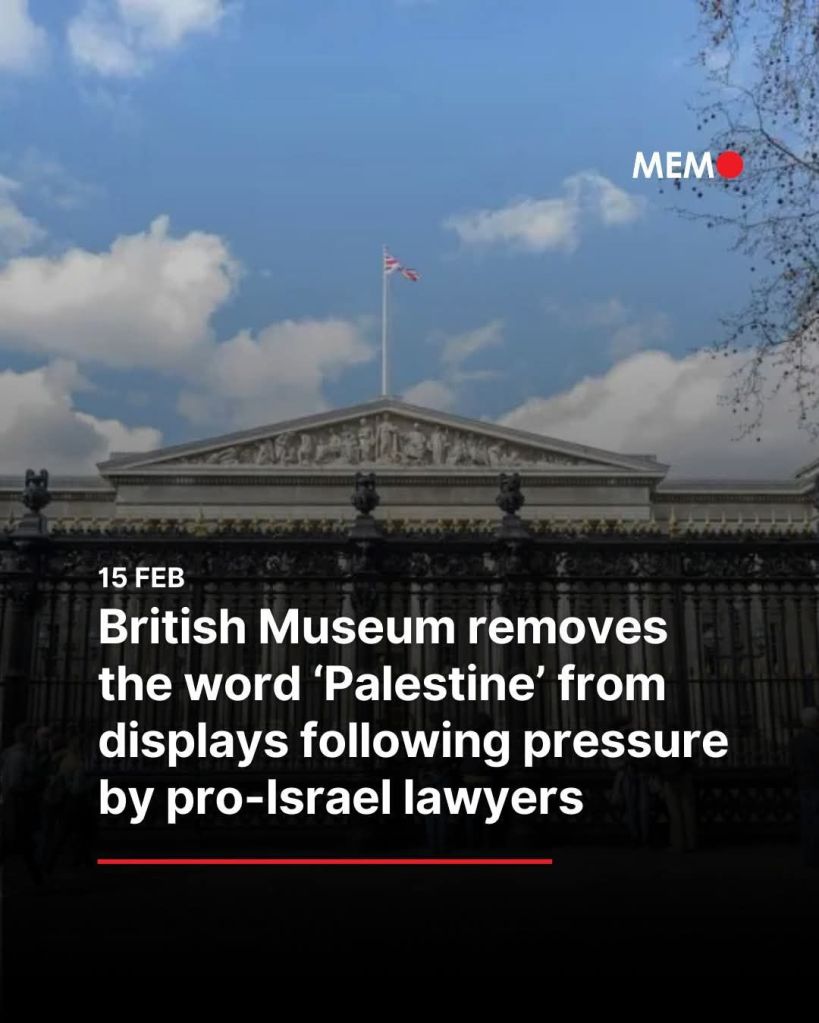
The British Museum has removed the word Palestine from displays about the ancient Middle East following “concerns” by a UK-based Israeli advocacy group.
The British Museum has confirmed that it is reviewing and updating some gallery panels and labels after “Audience testing has shown that the historic use of the term Palestine … is in some circumstances no longer meaningful,” UK Lawyers for Israel (UKLFI) said in a statement on Saturday.
REALLY?
Coz…
https://www.britannica.com/topic/history-of-Palestine
history of Palestine
an 1885 snapshot from Encyclopædia Britannica
Albrecht Socin
Britannica Editors
History
Britannica AIAsk Anything
The use of Palestine today
The term Palestine refers generically to a geographic region along the eastern Mediterranean coast, in which Israel and the administrative entities of the West Bank and the Gaza Strip are today located. The term was in common use by the time of Herodotus, whose 5th-century bce History, about the Greco-Persian Wars, marked the earliest incontrovertible use of the word, and it has since been used to refer to the general region regardless of who ruled or inhabited it in a given period. Although the term Palestinian in a modern context usually denotes the inhabitants of Israel, the West Bank, and the Gaza Strip who are not Jewish Israelis, Jews in the region before the establishment of the state of Israel continue to be called Palestinian Jews, and the rich and continuous history of the Jewish people in the region is reflected in terms such as Palestinian Talmud, a formative work of Rabbinic Judaism that was compiled in Galilee at a time when Jews did not have autonomy.
Encyclopædia Britannica’s long life offers incredible insight into how Britons understood their world 150—even 250—years ago. We provide here a snapshot of what Palestine meant at the time of our ninth edition, decades before the Israeli-Palestinian conflict began. The entry is a particularly valuable artifact, not only because it predates today’s conflict, but also because of when it was written. At the time of the ninth edition’s publication (1870s–80s), a collapsing Ottoman Empire was instituting a massive land reform (see Tanzimat). The Ottoman state had begun selling off land for private ownership, spurring exploration and settlement by predominantly Christian Europeans who had centuries ago lost connection with the Holy Land. A British association called the Palestine Exploration Fund, founded in 1865 under the patronage of Queen Victoria, completed in 1877 a major survey of Palestine, which is referenced throughout the entry. This emerging European interest in Palestine—infused with endless curiosity about the history of the Old Testament and intoned with prospective commentary on the land’s commercial potential—coincided with the rise of Zionism, a movement that identifies Palestine as the Jewish homeland and led eventually to the establishment of the state of Israel in 1948. In delineating the borders of the Palestine region, the entry below uses as its starting point “the country seized and mainly occupied by the Hebrew people” in ancient times, indicating the importance placed on outlining Palestine according to biblical significance rather than geographic features or demographic considerations. The entry concludes with a comment, perhaps startling for a modern reader, that reflects a contemporary interest in settling Europeans in the area: “As long as the Turks hold rule over the country successful colonization is hardly possible.”
Let’s call it what it is…
The British museum is run by bigots who accept orders from Israel.
 Tangents Brand : Music, Comics & Stories & Shizzle
Leave a comment