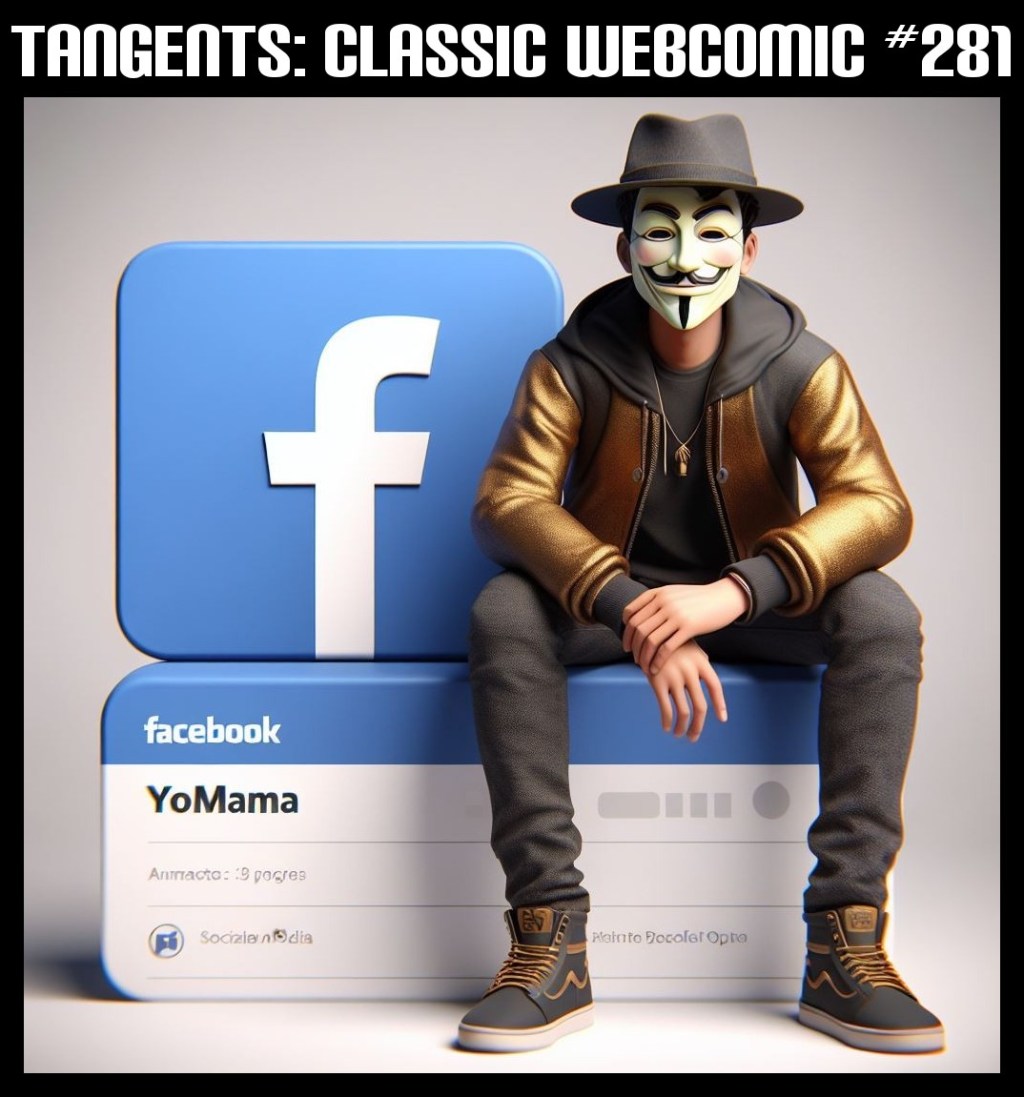


Social media right now…
Prompt Posted to Creative AI Explosions by : Kalawole Suleixman
Bing prompt : Create a 3D illustration of an animated character sitting casually on top of a “Facebook” social media logo. The character must wear a hat and guy Fawkes mask mask and modern casual clothing, such as a gold and dark jacket, jeans and sneakers. The background of the image is a social media profile page with a username “YOMAMA” and a corresponding profile photo.
The ubiquity of social media platforms such as Facebook has undeniably revolutionized the way we connect and interact with others, but it has also given rise to a fundamental issue: the lack of trust in people’s identities. One cannot help but question the authenticity of the identities presented on such platforms, considering the ease with which these identities can be fabricated and manipulated. The disconcerting reality is that anonymity and pseudoanonymity are pervasive in the digital realm, making it alarmingly effortless for individuals to assume false personas and deceive others for a myriad of purposes.
This inherent lack of verifiability regarding individuals’ identities on Facebook and other social media sites engenders an environment ripe for misinformation, manipulation, and fraudulent activities. Without concrete proof of authenticity, the trustworthiness of the information disseminated and the individuals behind it remains questionable. Moreover, the potential for malicious actors to exploit this lack of accountability for nefarious purposes cannot be underestimated. From spreading false narratives to perpetrating identity theft and online scams, the repercussions of unchecked and unverified digital identities are profound and far-reaching.
It is imperative for users to approach the content and identities encountered on social media with a healthy skepticism, cognizant of the fact that these platforms are virtual landscapes where appearances can be deceiving. As these platforms continue to blur the line between reality and artifice, it is crucial for users to exercise discernment and critical thinking when engaging with the plethora of identities they encounter. Without empirical evidence of identity verification, it would be imprudent to wholeheartedly trust the individuals behind the digital facades, understanding that the ease of identity falsification is an unfortunate reality of the digital age.
In conclusion, the prevalent susceptibility of online identities to fabrication and manipulation poses a significant threat to the integrity and trustworthiness of social media interactions. The absence of a robust mechanism for identity verification lays bare the stark reality that the digital personas encountered on these platforms may deviate significantly from their real-life counterparts. Thus, a profound skepticism regarding individuals’ identities on Facebook and similar platforms is not only prudent but essential in navigating the intricate web of digital interactions.
 Tangents Brand : Free Entertainment, no BS
Leave a comment