



Opening:
In the quaint, seemingly peaceful town of Maplewood, a sinister secret lingered like a shadow at dusk. Schoolgirl Felicity Parker, beloved by her peers and known for her bright smile that mirrored the morning sun, vanished into the dense embrace of the local forest. It was a path she had traversed countless times, a path etched into her memory as deeply as her own name. Yet, on this fateful day, an eerie stillness clung to the air, a stillness that unnerved even the bravest of hearts.
Unbeknownst to Felicity, a pair of watchful eyes trailed her every step, hidden within the forest’s ancient embrace. The trees, tall and foreboding, stood as silent witnesses to the unfolding horror. As the sun dipped below the horizon, casting long shadows across the path, Felicity’s familiar journey took an irreversible turn, leading her into the clutches of a darkness that awaited with bated breath.

Chapter 1: The Forest Whispers
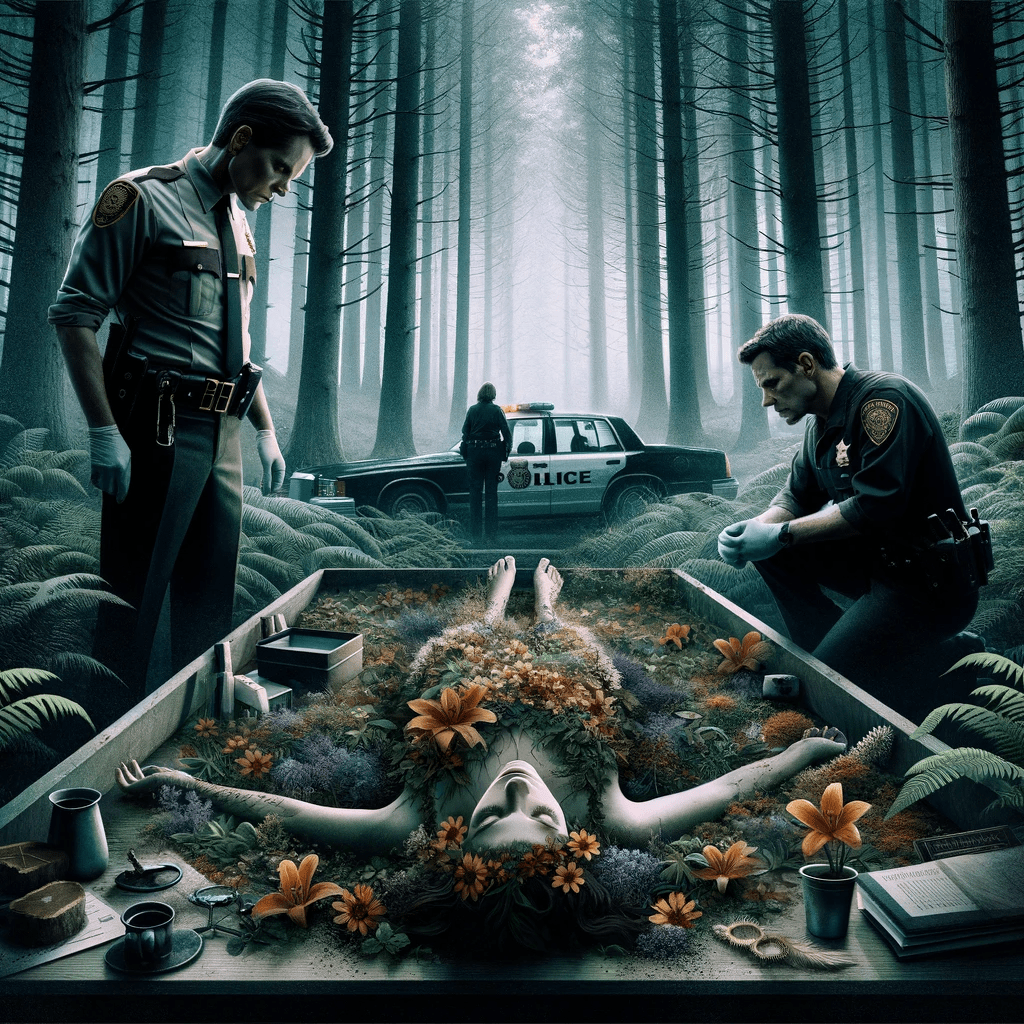
Maplewood, a town where stories whispered through the rustling leaves and lingered in the air like a forgotten melody, was now cradled by a silence that spoke of unspeakable things. Detective Jenna Alton, a woman whose presence commanded attention with a quiet, unassuming power, had seen more than her fair share of tragedies. But the sight that greeted her in the dense, shadowy woods was something even her seasoned heart struggled to comprehend.
Felicity Parker lay there, a picture of serene repose that belied the violence of her end. Her lifeless form, adorned with a crown of wildflowers, seemed almost at one with the forest floor. Jenna felt a chill creep up her spine as she took in the scene, the eerie tranquility of it all. It was as if the forest itself had chosen to honor the girl with its own somber ritual.
David Kane, Jenna’s deputy, a man whose rugged exterior masked a deeply intuitive mind, joined her. Together, they surveyed the scene, their experienced eyes searching for clues in the twilight. The forest, with its dense canopy and tangled underbrush, was a labyrinth of secrets, and Felicity’s body was a tragic enigma at its heart.
“The flowers,” Jenna mused aloud, her voice barely above a whisper. “They’re fresh, picked this morning, I’d wager. This wasn’t just a murder; it was a statement.”
Kane nodded, his gaze lingering on the delicate blooms. “It’s like he’s mocking us, laying her out here like some… some twisted version of Sleeping Beauty.”
As they combed through the area, their movements deliberate and respectful, Jenna couldn’t shake the feeling that they were being watched. The forest seemed alive, its whispers almost discernible. Was it mourning Felicity or concealing the darkness that took her?
In the days following the discovery, Jenna dove into Felicity’s life, unraveling the threads of her existence in search of a motive, a clue, anything. She spoke to Felicity’s friends, teachers, and family, piecing together the portrait of a girl loved by many, envied by some, but seemingly harmed by none.
Meanwhile, Maplewood, once a tapestry of community and warmth, transformed. Doors were locked earlier, conversations hushed as the town grappled with the reality of a predator in their midst. Parents held their children a little tighter, and the carefree laughter of youth was replaced by a tangible fear.
Kane and Jenna found themselves at the heart of this maelstrom, the burden of unearthing the truth weighing heavily on them. As they delved deeper, the patterns began to emerge – the meticulous planning, the deliberate display, the ominous flowers. It was a message written in the language of terror, and deciphering it was their only hope to prevent another tragedy.
As the investigation continued, Jenna felt the case seeping into her bones, the details blurring into her own life. The image of Felicity, peaceful yet violated, haunted her dreams, a specter refusing to be laid to rest. In the quiet moments, Jenna found herself looking into the mirror, wondering what darkness lurked beneath the surface of ordinary faces.
And in the depths of the forest, the whispers grew louder, as if the trees themselves were trying to tell their own story of the horror they had witnessed.
Chapter 2: The Unseen Eyes
In the aftermath of Felicity Parker’s death, a palpable tension gripped Maplewood. The town, once a vibrant tapestry of communal life, now lay under the shadow of an unspoken dread. Detective Jenna Alton, her sharp instincts honed by years on the force, sensed the change. The air felt heavier, the smiles of townsfolk more strained, as if everyone carried the weight of a secret they dared not voice.
Jenna’s thoughts were constantly drawn back to the crime scene. The image of Felicity, lifeless yet adorned with care, disturbed her. It was as if the killer wanted to communicate something intimate and twisted through this act. This wasn’t just a murder; it was a performance, and the audience was the entire town of Maplewood.
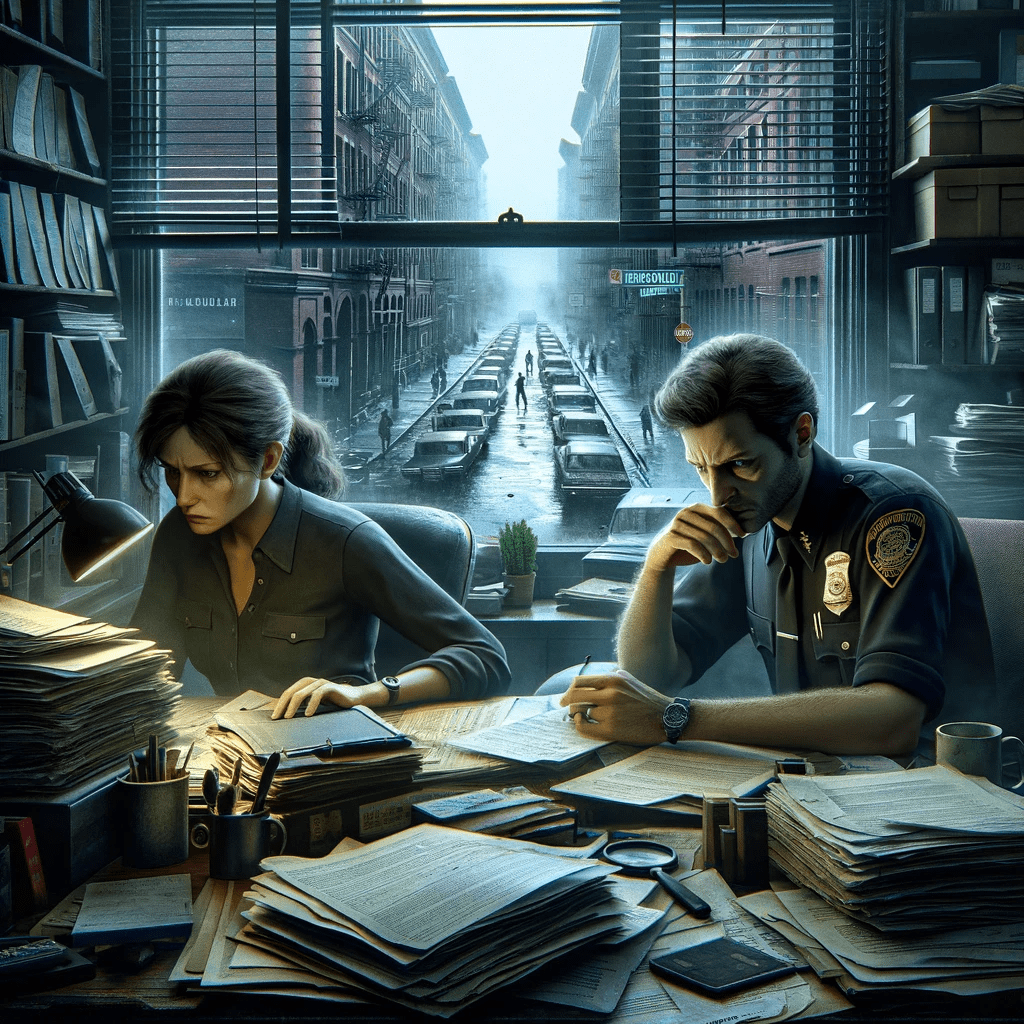
David Kane, her deputy, shared her unease. As they sat in the dimly lit office, poring over files and witness statements, a sense of futility hung in the air. “It’s like chasing shadows,” Kane muttered, frustration etched on his face. “We know he’s out there, watching, waiting. But we’re always a step behind.”
Jenna looked at Kane, his features shadowed by the dim light, and felt a surge of determination. They were not just fighting a killer; they were battling the pervasive fear he had sown. This was a fight for the soul of Maplewood.
Their only lead was the flowers left at the scene – a signature that felt both mocking and confessional. Jenna delved into the symbolism of the flowers, hoping to find a clue in their language. She consulted with botanists, studied local flora, and even delved into folklore. But the flowers remained a riddle, a beautiful yet macabre token of a deranged mind.
As days turned into weeks with no progress, the town’s fear morphed into paranoia. Neighbors viewed each other with suspicion, and the once-friendly streets of Maplewood took on a desolate feel. The killer had not just taken a life; he had stolen the town’s sense of security, leaving behind a community frayed at the edges.
Jenna felt the pressure mounting. The mayor demanded results, the media circled like vultures, and the townsfolk’s trust in the police waned. Each morning, she braced herself for news of another victim, another life snuffed out under the guise of twisted artistry.
Amidst this, Jenna found herself drawn to the forest, the scene of the crime. She walked the same path Felicity had, trying to see what she had seen, feel what she had felt. The forest was a silent witness to the tragedy, its trees standing like solemn sentinels. Jenna wondered if the answers they sought were hidden in its depths, in the whispers of the leaves and the secrets of the shadows.
In these quiet moments, Jenna felt the presence of the unseen eyes upon her. She knew the killer was out there, biding his time, reveling in the chaos he had created. The thought sent a shiver down her spine, but it also steeled her resolve. She would not rest until she caught a glimpse into the abyss that had claimed Felicity, until she confronted the darkness that lurked in the unseen corners of Maplewood.

Chapter 3: Echoes of Desolation
Maplewood, a town once buoyant with the symphony of everyday life, now echoed with a hollowness that crept into every nook. The citizens, their faces etched with a collective unease, moved through their days in a daze, as if wading through a nightmare they couldn’t wake from. Detective Jenna Alton, her spirit dogged by the relentless pursuit of an elusive killer, felt this shift acutely. The once familiar streets now seemed alien, as though the very landscape had been altered by the tragedy.
In her office, cluttered with files and the remnants of countless cups of coffee, Jenna poured over the details of the case. Each piece of evidence seemed to mock her, offering a glimpse into the killer’s mind but no clear path to his identity. “It’s like he’s playing a game with us,” she muttered, her voice a mix of frustration and awe.
Deputy David Kane, his usual stoic demeanor fraying at the edges, nodded in agreement. “And we’re just pawns,” he added, his gaze lost in the sea of case files. “Pawns in his sick game.”
The second victim, Kate Bright, a vibrant soul now reduced to a file on Jenna’s desk, seemed to be a message from the killer – a taunt. The way Kate was displayed, much like Felicity, with meticulous care, suggested a ritualistic pattern. The flowers, again present at the scene, were a signature that felt both personal and perverse.
Jenna found herself drawn to these floral signatures, a bizarre breadcrumb trail left by the killer. She pondered over their meaning, each species meticulously chosen for a reason she struggled to fathom. Was it a clue to his identity or just a red herring meant to lead them astray?
The investigation became a fixture in Jenna’s life, consuming her thoughts and dreams. She saw the killer’s handiwork in the shadows of her room, in the patterns of the falling leaves. The boundary between her world and the killer’s blurred, leaving her to wonder if she was getting closer to the truth or spiraling into an abyss of her own making.
Maplewood’s descent into fear was palpable. The town meetings, once filled with mundane concerns, were now forums for airing suspicions and fears. Trust, the fabric that held the community together, was unraveling, thread by thread. Jenna watched this transformation with a heavy heart, knowing that each passing day without answers only served to tighten the knot of collective anxiety.
Kane, ever the pragmatist, focused on the tangible. “We need to find a pattern, something we’re missing,” he insisted, his eyes scanning the maps and photos pinned to the wall. “There has to be a reason he chose these girls, these locations.”
Jenna, however, felt drawn to the intangible – the killer’s mindset, the psychological underpinnings of his actions. She delved into criminal psychology, consulted with profilers, and even revisited old cases for parallels. But the elusive nature of the killer, like a specter in the night, remained just out of reach.
As the investigation plodded on, Jenna and Kane found themselves at a crossroads. The choices they made, the paths they pursued, could either lead them to the killer or further into the labyrinth of uncertainty that Maplewood had become. And in the quiet moments, Jenna couldn’t shake the feeling that the killer was watching, amused by their struggle, biding his time until he struck again.
Chapter 4: Unspoken Bonds
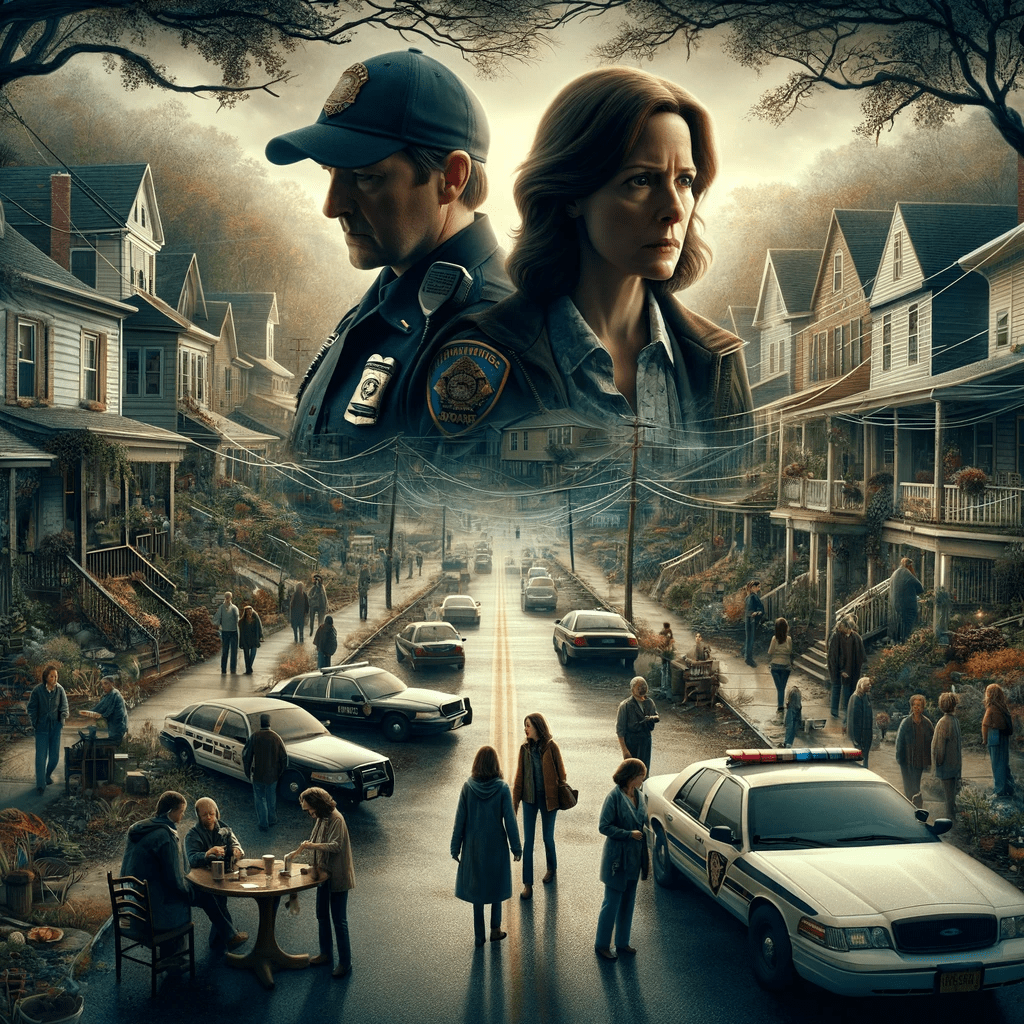
Maplewood, a town once brimming with the simple joys of suburban life, now wore a cloak of unease. The streets, lined with maple and oak trees, stood as silent observers to the town’s unspoken grief. In the midst of this somber atmosphere, Detective Jenna Alton found herself reflecting on the intricate tapestry of human connections that the tragedy had unraveled.
Jenna, with her keen insight into the human psyche, recognized the profound impact the murders had on the community. The town was not just a backdrop for the investigation; it was a living, breathing entity, each resident a thread in the larger story. She saw the fear in the eyes of the parents as they dropped their children off at school, the hushed conversations at the local diner, the way people clung to their routines as a lifeline.
As Jenna delved deeper into the lives of the victims, she discovered a web of relationships, some overt and others hidden beneath the surface. Felicity and Kate, the two girls whose lives had been brutally cut short, were more than just victims; they were daughters, friends, and dreams unfulfilled. Their absence created ripples that touched every corner of Maplewood.
David Kane, his usual pragmatic approach tempered by the gravity of the situation, worked alongside Jenna. Together, they sifted through the layers of the girls’ lives, looking for connections, for motives that might lead them to the killer. But with each turn, the mystery seemed to deepen, the killer’s identity shrouded in ambiguity.
The investigation led Jenna to the families of the victims. In the tear-streaked faces of the parents, she saw a reflection of her own hidden fears and uncertainties. These conversations, heavy with sorrow and unspoken questions, were a stark reminder of the fragility of life and the bonds that hold us together.
Kane, too, found himself affected by the case in ways he hadn’t anticipated. The stoic deputy, usually a fortress of strength and resolve, felt the weight of the tragedy. He saw in the eyes of the town’s youth a reflection of his own daughter, igniting a protective instinct that fueled his determination.
As the days passed, Jenna and Kane became more than just investigators; they became part of the fabric of Maplewood. Their presence at community meetings, their interactions with the townsfolk, all served to strengthen the bond between the police and the community.
In the midst of this, Jenna grappled with the duality of her role. She was both an outsider, a bringer of uncomfortable truths, and an integral part of the community’s healing process. This delicate balance, the dance between empathy and objectivity, became the cornerstone of her approach to the case.
The investigation, while frustrating in its lack of progress, was more than a pursuit of justice. It was a journey into the heart of a community, an exploration of the ties that bind us together in times of crisis. Jenna and Kane, in their quest to uncover the truth, found themselves woven into the very story they were trying to unravel. And in the silent spaces between the facts and evidence, they discovered the unspoken bonds that define us all.
Chapter 5: The Veil of Darkness
In the heart of Maplewood, where the shadows of ancient trees stretched long and twisted across the ground, a pervasive sense of dread had settled like a dense fog. The town, once a beacon of suburban tranquility, now echoed with a melancholic resonance, a chilling reminder of the darkness that had crept into its very soul.
Detective Jenna Alton, her mind a labyrinth of theories and conjectures, felt the oppressive weight of the unsolved murders. The killer, a phantom lurking in the unseen corners of Maplewood, seemed to mock her at every turn. His actions, shrouded in a macabre mystery, were like a dark riddle wrapped in an enigma.
The third victim, a young girl named Emily, had been found under the pale moonlight, her lifeless form lying beside the serene lake. The scene, meticulously arranged with a haunting precision, bore the same chilling signature – a bouquet of flowers, their vibrant colors a stark contrast to the pallor of death.
Jenna, accompanied by Deputy David Kane, stood at the water’s edge, the reflection of the moon quivering on the surface. The night air was thick with the scent of pine and the unspoken fear that another life could be extinguished at any moment.
“The killer, he’s toying with us,” Jenna whispered, her voice barely audible above the gentle lapping of the water. “Each murder, more elaborate than the last, as if he’s perfecting his craft.”
Kane, his face etched with the same haunted look that had become all too familiar, nodded in agreement. “It’s like he’s drawing us into his world, a world where he is the master and we mere spectators,” he replied, his eyes scanning the darkness.
As they delved deeper into the investigation, the boundaries between reality and nightmare began to blur. Jenna’s dreams were filled with twisted visions of the forest, the lake, and the unseeing eyes of the victims. The killer seemed to haunt her very thoughts, a spectral presence that eluded capture.
The town of Maplewood, its streets now deserted as night fell, became a ghost town, a shell of its former self. The laughter of children was replaced by an eerie silence, and the once welcoming homes stood like empty tombs, their windows dark and lifeless.
In this atmosphere of fear and paranoia, Jenna and Kane continued their relentless pursuit. They combed through old case files, interviewed countless suspects, and chased down every lead, no matter how faint. But the killer remained a step ahead, his identity concealed behind a veil of darkness.
Jenna, her resolve tested by the mounting pressure and the toll of the investigation, found herself questioning her own sanity. Was she chasing a ghost, a figment of her own tormented imagination? Or was the killer closer than she dared to imagine, hiding in plain sight?
The town of Maplewood, caught in the grip of an unrelenting terror, waited with bated breath for the next chapter in the killer’s macabre tale. And in the stillness of the night, the only sound that echoed through the empty streets was the whisper of the wind, as if the very trees were mourning the innocence lost to the veil of darkness.

Chapter 6: The Disquieting Mosaic
Maplewood had transformed. The town, once a picture of idyllic suburban charm, now resembled a scene from a disquieting story. The streets, lined with their perfect rows of houses, seemed to watch with a knowing gaze, as if hiding secrets behind their shuttered windows. The townsfolk moved with a wary tension, their smiles brittle, their eyes darting to shadows. Detective Jenna Alton felt this change acutely, a dissonance that played on her nerves like a discordant melody.
The investigation into the murders had taken a toll on Jenna. Sleep had become a rare commodity, her dreams infiltrated by the haunting images of the crime scenes. The killer, an enigma wrapped in the darkness of human psyche, had become a constant presence in her thoughts.
Deputy David Kane observed Jenna’s growing obsession with concern. “We’re missing something,” he said one evening as they sat in the dimly lit office, surrounded by the clutter of their relentless pursuit. “It’s like a puzzle, and we can’t find the missing piece.”
Jenna nodded, her mind racing through the myriad of clues, witness statements, and autopsy reports. “It’s a mosaic,” she murmured. “Each murder, a piece of a larger picture we can’t quite see yet.”
The third victim, Emily, had been found by the lake, a hauntingly beautiful scene that belied the horror of the act. The careful placement of the body, the selection of the flowers, it all spoke of a ritualistic pattern. But to what end?
Jenna and Kane delved into the histories of the victims, searching for a common thread. Their lives, however, seemed as disparate as the town itself. Yet, Jenna couldn’t shake the feeling that the answer lay hidden in the fabric of Maplewood’s daily life, in the unspoken truths and the ignored whispers.
As the investigation continued, the town’s facade of normalcy began to crumble. Stories and rumors, long buried under the surface of polite conversation, started to emerge. Old grievances, hidden resentments, and secret relationships came to light, painting a picture of a community far more complex and troubled than it appeared.
In this unsettling atmosphere, Jenna found herself looking at the townsfolk with a new perspective. Each interaction, each overheard conversation, seemed to hold potential clues. The killer, she realized, was not an outsider but a product of this very environment, a creature born from the hidden undercurrents of Maplewood.
The sense of paranoia grew as the killer remained at large. The town meetings, once a place for communal bonding, now crackled with an underlying tension. Accusations were whispered, fingers pointed, and trust eroded. Jenna watched this transformation with a heavy heart, knowing that the killer’s true victory was the disintegration of the community’s spirit.
As Jenna lay awake at night, the faces of the victims haunting her, she pondered the nature of evil. Was it an aberration or a part of the human condition, lurking beneath the veneer of civility? The answer seemed to lie just beyond her grasp, hidden in the disquieting mosaic of Maplewood, a town forever changed by the shadow of unspeakable acts.

Chapter 7: In the Heart of Fear
Maplewood, under the suffocating grip of an unseen terror, had become a town not just of shadows, but of whispers and half-seen movements in the periphery. The very air seemed charged with an unspoken dread, a sense of anticipation for a horror yet to unfold. Detective Jenna Alton, her senses honed to the subtle undercurrents of fear, felt this transformation deeply. The killer, a specter haunting the edges of her thoughts, seemed an integral part of this transformed landscape.
As Jenna walked the streets of Maplewood, the familiar houses and shops now seemed alien, their facades masking an unspoken turmoil. The town had taken on a character of its own, a personality shaped by the collective fear and suspicion of its inhabitants. Every glance held a story, every closed door a secret.
Deputy David Kane, usually a bulwark against the tide of fear, found himself affected by the town’s palpable anxiety. “It’s like we’re walking in a dream,” he remarked to Jenna, his voice tinged with unease. “A nightmare we can’t wake up from.”
Their investigation had become more than a hunt for a murderer; it was a descent into the very heart of fear. The killer’s actions, steeped in ritual and symbolism, were like ripples on the surface of a dark pond, hinting at the depths beneath. Jenna found herself drawn to these depths, a pull both terrifying and irresistible.
The latest victim, a young teacher named Sarah, had been found in the heart of the town park, her body arranged in a chilling parody of a picnic. The setting, so mundane and yet so macabre, spoke of a mind that reveled in the corruption of the everyday, the twisting of normalcy into something grotesque.
As Jenna and Kane delved deeper, the line between the investigation and their own lives began to blur. The killer’s presence, though unseen, was a constant companion, a whisper in the dark that echoed their deepest fears. The town of Maplewood, once a haven, now seemed to hold them in a claustrophobic embrace.
In this atmosphere of heightened tension, the townsfolk began to turn on each other. Accusations flew, old rivalries and hidden jealousies surfacing like dark secrets. Jenna watched this unraveling with a sense of despair, knowing that the killer had not just taken lives, but had also stolen the town’s soul.
One night, as Jenna walked through the deserted streets, the silence was almost tangible. The moon, a sliver of silver in the dark sky, cast elongated shadows that seemed to dance with a life of their own. In this surreal landscape, Jenna felt a moment of clarity. The killer was not just an external threat to be hunted; he was a manifestation of the town’s own hidden darkness, a darkness that lurked in the heart of every resident.
As the investigation reached its crescendo, Jenna and Kane found themselves not just confronting a murderer, but the very essence of fear itself. They realized that to catch the killer, they would have to venture into the shadows of the human soul, to confront the darkness that resided there. And in doing so, they would have to face their own fears, fears that had taken root in the heart of Maplewood.

Epilogue: When the Leaves Settle
In the aftermath of the harrowing events, Maplewood gradually began to stitch itself back together. The once palpable shroud of fear slowly lifted, giving way to a cautious hope. Detective Jenna Alton, having confronted the darkness both in the town and within herself, found a newfound resilience. The case had changed her, etching its story deep into her being.
As autumn arrived, bringing with it a cascade of golden leaves, Maplewood looked almost normal. Children played in the streets, laughter echoing in the crisp air, a sound that had once seemed lost forever. Yet, for Jenna and Deputy David Kane, the town held new meanings. Every smile hid a story of survival, every gaze carried the weight of unspoken memories.
The killer, now just a shadow in the town’s history, had left an indelible mark. But in facing this darkness, the people of Maplewood discovered a strength they hadn’t known. Bonds were rebuilt, some even stronger for having been tested by the fires of adversity.
Jenna, walking through the town square, felt a sense of peace. The case was closed, but the journey, the introspection it had sparked, continued. Maplewood, with its scars and its hopes, stood as a testament to the resilience of the human spirit, a spirit that endures even when the leaves settle.

 Tangents Brand : Free Entertainment, no BS
Leave a comment