
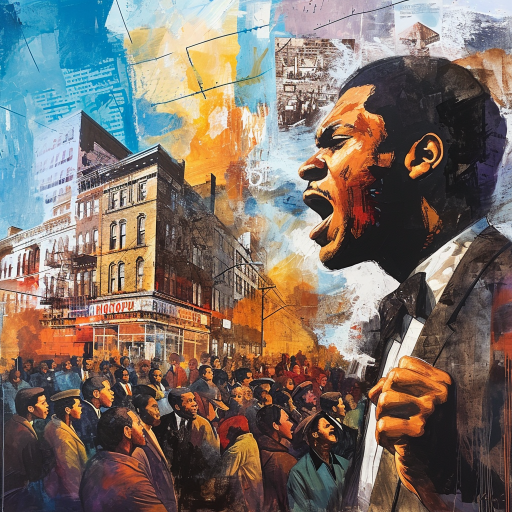
Echoes in the Dawn: The Last Stand of Fred Hampton
In the heart of Chicago’s West Side, as the tumultuous 1960s drew to a close, a story of hope, betrayal, and unyielding courage unfolded. Fred Hampton, a young, vibrant leader in the Black Panther Party, stood as a beacon of change, championing a revolution not of violence, but of unity and justice. His words resonated deeply, “You can jail a revolutionary, but you can’t jail the revolution.” In the shadows, however, a sinister plan brewed, orchestrated by those who saw Hampton’s vision of unity as a dire threat to the established order. As the dawn of December 4, 1969, approached, it was not the birth of a new day that it heralded, but the eclipse of a revolution, a chapter soon to be marked by gunfire, grief, and an enduring fight for justice.

Chapter 1: The Gathering Storm
In the late 1960s, Chicago’s streets were alive with the sounds of change. Among these voices, Fred Hampton, a 21-year-old chairman of the Illinois chapter of the Black Panther Party, stood out. His charismatic speeches, imbued with a passion for racial and economic justice, inspired many. “We say that we will work with anybody and form a coalition with anybody that has revolution on their mind,” Hampton proclaimed, his words echoing through the communities he sought to uplift.
Hampton, born on August 30, 1948, grew up in Maywood, a suburb of Chicago, where he excelled in academics and athletics. However, it was his exposure to racial injustice at an early age that kindled his activist spirit. Inspired by the civil rights movement, he joined the NAACP, quickly rising to leadership and notoriety for his organizing skills. But it was in the Black Panther Party that Hampton found his true calling, focusing on programs like free breakfasts for children and medical clinics, which provided much-needed services to impoverished Black communities.
Meanwhile, the FBI, under J. Edgar Hoover, viewed the Panthers, especially charismatic leaders like Hampton, as a profound threat to national security. The agency’s COINTELPRO program was already in full swing, aimed at surveilling and disrupting civil rights movements. Hampton, with his potential to unify various racial and ethnic groups, was marked as a particularly dangerous figure. Hoover was determined to prevent the rise of what he called a “Black Messiah” who could electrify and unify the black nationalist movement.
In Chicago, Hampton’s efforts to forge alliances with other minority groups and his calls for a unified front against racial oppression only intensified the government’s resolve to silence him. He had a way of reaching people, transcending the barriers that had long divided them. “We understood that politics is nothing but war without bloodshed and war is nothing but politics with bloodshed,” Hampton once said, encapsulating his approach to activism.
As 1969 wore on, Hampton’s influence grew. His work in the community and his powerful oratory started drawing larger crowds, his vision for a united front against injustice gaining momentum. But as his star rose, so did the determination of those who wished to extinguish it. In the corridors of power, plans were being laid, dark and foreboding, that would seek to quell his rising voice.
The stage was set for a confrontation that would shake the very foundations of the civil rights movement. It would be a clash not just of ideologies, but of a deeply entrenched system against a burgeoning revolution for equality and justice.

Chapter 2: A Night of Betrayal
On the night of December 3, 1969, Fred Hampton taught a political education class at a local church, an event attended by many Panther members. Afterward, he returned to his Monroe Street apartment, accompanied by his close associates and his pregnant fiancée, Deborah Johnson. Unbeknownst to them, William O’Neal, who was Hampton’s bodyguard and a trusted member of the Panthers, had betrayed them. O’Neal, coerced by the FBI, had provided detailed plans of the apartment to the authorities and had drugged Hampton’s drink that evening, ensuring he would be unconscious during the raid.
In the early hours of December 4, a team of Chicago police officers, armed with a detailed map and a mission to dismantle the Panther leadership, prepared to strike. As they quietly approached the apartment, there was a sense of foreboding in the air. The police burst through the door, guns blazing, in a chaotic and violent assault. The Panthers, caught off-guard and largely unarmed, were unable to mount a defense.
In the hail of gunfire, Mark Clark, on guard duty, was shot and killed instantly. The bullets then found their way to Hampton, who lay drugged and unconscious in his bed. His fiancée, Deborah Johnson, tried desperately to shield him with her body, but it was in vain. Fred Hampton was shot twice in the head, a blatant execution rather than an act of self-defense by the police. The apartment was riddled with bullets, evidence of the unprovoked ferocity of the attack.
The raid, which lasted only a few minutes, left a trail of bloodshed and devastation. Four other Panthers were seriously injured, and the survivors were arrested on trumped-up charges. The brutality of the raid was a clear message from the authorities – the Black Panther Party’s rising influence and Hampton’s unifying vision were intolerable to the status quo.
In the aftermath, the apartment was left unguarded, allowing members of the community to witness the carnage. The bullet holes in the walls, the blood-stained mattress where Hampton had lain, and the overwhelming evidence of a one-sided shootout dispelled any myths the authorities tried to propagate about the raid. The truth was clear to all who walked through that shattered doorway: Fred Hampton had been assassinated.
The outrage was immediate and intense. Hampton’s murder was not just a blow to the Panther Party but to the entire civil rights movement. A young leader, full of potential and promise, had been silenced, but his ideas and his spirit could not be so easily extinguished. The community rallied, mourning the loss of Hampton and vowing to continue his fight for justice and equality. The Panthers, despite being rocked by this severe blow, were determined not to let Hampton’s death be in vain.

Chapter 3: Aftermath and Echoes of Injustice
In the wake of the raid, the impact of Hampton’s assassination resonated far beyond the bullet-riddled walls of the Monroe Street apartment. The Black community of Chicago, already grappling with systemic injustices and economic disparities, found itself bereft of a unifying figure who had embodied hope and change. Hampton’s ability to bring together various factions and his efforts to address community needs had made him a beloved figure, and his death left a void that was hard to fill.
The Panthers and their allies were quick to denounce the raid as a cold-blooded assassination. They opened the doors of the apartment to the public, allowing thousands to witness the aftermath firsthand. This move not only exposed the extent of the violence used against them but also helped to counter the false narrative being pushed by law enforcement and some media outlets. The narrative of a violent shootout was debunked, as evidence clearly showed that the Panthers had not fired a single shot.
As the community mourned, the legal battle began. The families of Hampton and Clark, along with the survivors of the raid, filed a civil lawsuit against the city, county, and federal governments. The lawsuit, led by attorneys from the People’s Law Office, was not just about seeking monetary compensation; it was a fight for truth and accountability.
Throughout the long and arduous legal process, the depth of the conspiracy against Hampton and the Panthers was revealed. Documents uncovered during the trial exposed the FBI’s COINTELPRO program and its role in targeting black leaders and movements. The lawsuit also brought to light the collusion between the FBI and local law enforcement in planning and executing the raid. Despite these revelations, the path to justice was fraught with obstacles and setbacks.
In 1982, after years of litigation, the lawsuit brought by the families of Fred Hampton and Mark Clark, and the survivors of the raid, was settled for $1.85 million. This settlement, paid by city, county, and federal governments, represented a significant victory for the plaintiffs. However, it was a bittersweet outcome as no criminal charges were ever filed against those responsible for the raid. The lack of criminal accountability left a lingering sense of injustice. Fred Hampton’s mother, Iberia Hampton, echoed this sentiment, feeling that the perpetrators had essentially “gotten away with murder.” This settlement, while a financial acknowledgment of the wrongs committed, fell short of delivering full justice for the egregious actions of December 4, 1969.
The assassination of Fred Hampton had profound implications, resonating far beyond the immediate aftermath of the raid. It left the Black community in Chicago without a charismatic leader who had been effectively unifying various groups and addressing pressing community needs. The Panthers and their allies, in response to the raid, took proactive steps to reveal the truth. They opened the raided apartment to the public, allowing thousands to witness the aftermath and effectively countering the false narrative propagated by law enforcement. This act of transparency was crucial in debunking the narrative of a violent shootout, as it became evident that the Panthers had not fired back during the raid.
The tragedy of Fred Hampton’s death and the ensuing legal battle underscored the systemic challenges faced by civil rights movements in their quest for justice and equality. It highlighted the extent to which government agencies, such as the FBI, would go in their efforts to suppress and discredit movements like the Black Panther Party. The COINTELPRO program’s role in targeting black leaders and movements, as revealed during the trial, painted a stark picture of the government’s concerted efforts against civil rights activism.
While the settlement in 1982 marked a close to the legal chapter of this story, the broader narrative of Fred Hampton’s life and legacy, and the struggle for civil rights, continues to resonate. His assassination remains a potent symbol of the challenges faced by those who stand up against systemic injustice and the enduring fight for equality and social justice.
 Tangents Brand : Free Entertainment, no BS
Leave a comment