



OPENING:
In the waning light of a somber evening, Meredith Langley stood alone, her silhouette cast long against the fading sun. The house behind her, a once vibrant sanctuary of love and laughter, now whispered secrets of a darker hue. Meredith’s eyes, cold as the dusk, reflected a turmoil that churned deep within her soul. The plan had been meticulous, a cruelly orchestrated symphony of deceit and malice. She had meticulously tampered with the family car, a subtle manipulation of the brake lines, ensuring a tragic but seemingly accidental descent into the ravine. Her hands, though physically cleansed, felt forever stained with the betrayal of her flesh and blood. As the night drew its curtain, an eerie stillness enveloped the scene. But within the house’s aging walls, restless spirits began to stir, their whispers growing into a chorus of retribution. Meredith, haunted by the echoes of her deed, stepped into the encroaching darkness, unaware that her true reckoning was yet to come.

Chapter 1: The Silent Witness-
The Langley residence, once a beacon of familial warmth, now stood as an eerie monument to tragedy. In the days following the accident, the community had rallied around Meredith, offering condolences and support. Yet, beneath the veneer of sympathy, whispered rumors began to swirl, feeding an undercurrent of suspicion.
Detective James Harrow, a man seasoned by years of untangling the webs of deceit, arrived at the Langley home. His keen eyes scanned the environment, searching for the unspoken truths that lingered in the air. Meredith greeted him with a practiced smile, her demeanor calm yet unnervingly detached.
As Harrow moved through the house, he noted the meticulous order, the absence of personal effects that once breathed life into the space. In the living room, a series of family portraits watched silently, their smiles frozen in time, a stark contrast to the grim reality that had unfolded.
In the garage, the remnants of the family car were a jigsaw of metal and memories. Harrow’s gaze lingered on the brake fluid stains, a seemingly innocuous detail that gnawed at his intuition. The official report had concluded an unfortunate failure of the brake system, but Harrow sensed an unsettling precision in the chaos.
Meredith, following his gaze, offered explanations laced with sorrow. Yet, her words seemed rehearsed, a script performed too many times. Harrow, his suspicions mounting, noted the absence of genuine grief in her eyes. It was as though she was an actor in a play, her role the mourning widow, but her heart absent from the part.
As evening approached, Harrow decided to revisit the crash site. The ravine, steep and unforgiving, told its own story. The trajectory of the car, the impact points, all spoke of a violent end. But it was the almost deliberate path to destruction that puzzled him. Nature was chaotic, yet this seemed orchestrated.
Back at the station, Harrow poured over the case files, his mind piecing together the fragments of truth. The life insurance policy, recently updated with a substantial payout, was a glaring red flag. The financial troubles that plagued the Langleys, once hidden behind closed doors, now came to light. Meredith’s alibi for the time of the accident was shaky, her whereabouts unaccounted for.
The next day, Harrow returned to the Langley residence. This time, his approach was more direct, his questions probing the layers of Meredith’s facade. She maintained her composure, yet Harrow noticed the subtle cracks in her armor, the fleeting moments of panic that danced in her eyes.
As he left the house, the wind carried whispers, voices that seemed to rise from the very walls of the Langley home. Harrow, a rational man, dismissed them as figments of his imagination. Yet, as he drove away, an unsettling feeling gripped him. There was more to this case than the evidence suggested, a hidden narrative that clawed its way from the shadows, desperate to be heard.
In the solitude of her home, Meredith watched Harrow’s car disappear down the road. A sense of triumph flickered in her eyes, but it was quickly overshadowed by a creeping dread. The house, once her sanctuary, now felt like a prison, its walls echoing with the accusatory whispers of her past. The ghosts of her family, though unseen, were ever-present, their silent judgement a constant reminder of her unforgivable sin.

Chapter 2: Echoes in the Darkness-
In the heart of the night, when shadows are deepest and the world is asleep, the Langley house seemed to breathe a life of its own. Meredith lay awake, her mind a tumultuous sea of guilt and fear. She could hear them – the faint whispers of her family, echoing through the hallways, a haunting chorus that refused to be silenced.
The ghostly presence of her husband, David, loomed large, his once kind eyes now pools of accusation. Their children, Lily and Sam, appeared in her dreams, their innocent faces twisted in confusion and betrayal. These spectral visitations, whether real or conjured by her tormented psyche, became her nightly tormentors.
Meredith’s days were spent in a haze, her once meticulous appearance giving way to a disheveled shadow of her former self. Friends and neighbors began to withdraw, their initial sympathy replaced by an uneasy wariness. The whispers of the town grew louder, rumors of Meredith’s involvement in the tragedy spreading like wildfire.
Meanwhile, Detective Harrow’s investigation deepened. He interviewed friends, family, and acquaintances, piecing together a portrait of the Langley family. Stories emerged of Meredith’s increasing isolation, her once vibrant personality replaced by a cold, distant demeanor. Colleagues spoke of David’s concerns about their finances, his unease about Meredith’s recent interest in their life insurance policy.
One evening, Harrow visited the local bar, a place where tongues loosened under the influence of alcohol. There, he encountered an old friend of David’s, a man burdened by the weight of a secret. Under the dim lights and the influence of drink, the man confessed to Harrow about a conversation he had with David weeks before the accident. David had expressed fears about Meredith, her strange behavior, and an unnerving obsession with death.
This revelation was a critical piece in Harrow’s puzzle, adding substance to his suspicions. He realized that Meredith’s facade was not just that of a grieving widow but a mask hiding a much darker truth.
Back at the Langley house, Meredith felt the walls closing in. She started to perceive her family’s presence not just at night but in the daylight hours. Their voices became louder, more insistent, a cacophony that drowned out her attempts at normalcy. The boundary between reality and the ethereal realm blurred, her sanity teetering on the edge.
In her desperation, Meredith sought out a medium, a conduit to the spirits she believed haunted her. The medium, an enigmatic figure with a penetrating gaze, listened to Meredith’s tale. With a solemn air, she conducted a séance, a bridge between the living and the dead. The room grew colder, the air charged with an unseen energy.
As the medium called out to the spirits, Meredith waited, her heart pounding in her chest. For a moment, there was silence. Then, a voice, unmistakably David’s, filled the room. It was not a voice of comfort but of condemnation. The medium’s eyes widened in horror, as she relayed a message from beyond: “The truth will be revealed. Justice will come.”
Meredith fled the séance, her mind a whirlwind of terror and disbelief. The voices followed her, their accusations a relentless echo in the darkness. Her own home, once a haven, had become a prison of her making, a house haunted not just by the spirits of her family, but by the specter of her own guilt.

Chapter 3: The Unraveling-
The once peaceful town of Willow Creek was now a place of whispers and sideways glances, its tranquility shattered by the tragedy of the Langley family. The local news had taken a keen interest in Meredith Langley, painting her as a figure shrouded in mystery and suspicion. Her every move was watched, her every action scrutinized.
Detective Harrow, following the trail of evidence, found himself at the office of Dr. Helen Reese, the psychiatrist who had treated Meredith. With a cautious eye on confidentiality, Dr. Reese shared insights into Meredith’s mental state. She spoke of a woman grappling with deep-seated guilt and paranoia, her sessions filled with talk of nightmares and haunting visions. Meredith, according to Dr. Reese, was a woman on the brink, torn between reality and a delusion of her own creation.
The detective pondered this new information, weighing it against the evidence he had gathered. He began to see Meredith not just as a suspect, but as a deeply troubled soul, caught in the web of her own deceit and terror.
Meanwhile, Meredith’s encounters with the apparitions of her family grew more intense. The specters of David, Lily, and Sam now appeared with startling clarity, their ghostly forms a constant reminder of her heinous act. They spoke to her, their words a mix of sorrow and accusation, a chorus of the dead that filled her days and nights with dread.
In her desperation, Meredith turned to old journals, seeking solace in memories of happier times. But the words on the pages twisted into condemnations, the ink bleeding into messages from beyond. “Why, Mother?” the pages seemed to scream, “Why did you do this to us?”
As the investigation continued, Harrow delved into the financial aspects of the Langley’s life. He uncovered a web of debt and desperation, a motive that painted a sinister picture. The life insurance policy, a substantial sum, was a beacon in the darkness of their financial despair. But for Harrow, it was the missing piece that connected Meredith to the crime.
In the heart of the town, gossip and speculation reached a fever pitch. The residents of Willow Creek, once sympathetic to Meredith’s plight, now viewed her with a mix of fear and suspicion. Her presence in the town became a source of unease, her haunted eyes and disheveled appearance a manifestation of a community’s worst fears.
Harrow, in a final attempt to uncover the truth, arranged for a reenactment of the accident. Experts and forensic analysts gathered at the ravine, piecing together the final moments of the tragic descent. The simulation revealed chilling details, the car’s path too precise, the failure of the brakes too convenient. The evidence pointed to a deliberate act, a conclusion that Harrow had long suspected.
As the truth began to emerge, Meredith felt the walls of reality crumbling around her. The voices of her family grew louder, their presence more oppressive. In a moment of lucidity, she realized the extent of her own madness, the horror of what she had done. The ghosts of her past, real or imagined, had become her jailers, their whispers a sentence she could never escape.
In the quiet of her home, Meredith sat alone, the weight of her guilt a crushing force. The line between the living and the dead had blurred, her world a labyrinth of shadows and echoes. She was trapped in a nightmare of her own making, a prisoner in a house haunted by the ghosts of her unforgivable sin.

Chapter 4: A Town’s Judgment-
As autumn leaves began to fall, painting Willow Creek in shades of amber and gold, the case of Meredith Langley reached a fever pitch. The town, once a tight-knit community, found itself divided. Some clung to memories of the woman they thought they knew, while others whispered of dark deeds hidden behind the facade of a grieving widow.
Detective Harrow, with a heavy heart, prepared to bring the case to a close. The evidence, circumstantial yet compelling, painted a damning picture. The reenactment of the accident, combined with the financial motive and Dr. Reese’s testimony about Meredith’s mental state, left little doubt in his mind. Meredith, he believed, was responsible for the tragedy that had befallen her family.
In the midst of this, a new witness came forward. A mechanic from the local garage, uneasy with what he knew, revealed a crucial detail. Weeks before the accident, Meredith had brought the family car in for a routine check. She had been particularly interested in the brake system, asking questions that, in hindsight, seemed ominous.
This revelation sent shockwaves through the investigation. Harrow, armed with this new evidence, felt the final piece of the puzzle click into place. The mechanic’s testimony, along with the other evidence, formed a chain that led to an inescapable conclusion.
Meanwhile, Meredith, increasingly isolated, found herself the subject of scorn and fear. Her trips to the market were met with cold stares and hushed conversations. Graffiti, cruel and accusing, appeared on her once pristine home. The town of Willow Creek had passed its judgment, and in their eyes, Meredith Langley was guilty.
As the pressure mounted, Meredith’s mental state deteriorated further. The spectral visions of her family became constant companions, their ghostly forms a tangible representation of her guilt. In her mind, the line between reality and illusion had all but disappeared. She conversed with these apparitions, arguing and pleading, seeking forgiveness in a world that had none to offer.
In a moment of despair, Meredith reached out to an old friend, seeking a lifeline in a sea of judgment. But the friend, torn between loyalty and the weight of public opinion, turned her away. The rejection was a crushing blow, leaving Meredith more alone than ever.
Harrow, in the final stages of the investigation, met with the district attorney. They reviewed the case, the circumstantial evidence weaving a narrative of premeditated crime. The decision was made to proceed with charges, the wheels of justice beginning to turn.
As the news of the impending charges spread, the atmosphere in Willow Creek grew more charged. The town, once a haven for Meredith and her family, had become an amphitheater of judgment, its residents both jury and executioner.
In the solitude of her home, Meredith faced the ghosts of her past, their accusations louder than ever. She realized that her fate was sealed, not just by the law, but by the collective condemnation of those around her. The house, once filled with the laughter of her children, now echoed with the whispers of a tragedy that had consumed not just a family, but an entire community.
Meredith Langley, once a beloved mother and wife, had become a pariah, her life a cautionary tale of how quickly love could turn to hate, and truth to suspicion, in the court of public opinion.

Chapter 5: In the Shadow of Truth-
The days grew shorter and the chill of winter began to seep into Willow Creek, mirroring the cold that had settled in the hearts of its residents. Meredith Langley, once a part of the community’s fabric, now found herself an outcast, her name synonymous with tragedy and betrayal.
Detective Harrow, in the wake of the decision to press charges, felt a lingering unease. Despite the mounting evidence, a part of him questioned the narrative that had formed around Meredith. He couldn’t shake the feeling that there were depths to this case that remained unexplored, secrets that lay buried beneath the surface.
In her home, Meredith grappled with the relentless haunting of her family’s spirits. Their presence was a constant reminder of her actions, a punishment that transcended any earthly court. Her conversations with the apparitions grew more fervent, her pleas for forgiveness more desperate. Yet, the spectral forms of David, Lily, and Sam offered no absolution, their silent stares a judgment far more severe than any words.
As the trial date approached, the media descended upon Willow Creek, their cameras and questions turning the town into a spectacle. The residents, caught in the glare of the national spotlight, found their lives dissected and analyzed by strangers. The tragedy of the Langley family had become a morbid fascination for the public, a story that fed the appetite for drama and mystery.
Meredith, facing the prospect of a trial, sought legal counsel. Her lawyer, a seasoned attorney named Jonathan Adler, approached the case with a mix of skepticism and curiosity. As he delved into the details, he began to uncover inconsistencies, small cracks in the prosecution’s narrative. The mechanic’s testimony, the timing of the brake failure, and the psychological profile of Meredith formed a complex puzzle that didn’t quite fit together.
Adler’s investigation led him to a little-known fact about the car model the Langleys owned. A series of similar accidents, attributed to a manufacturing defect in the brake system, had been reported. This revelation, buried under the sensationalism of the case, provided a potential alternative explanation for the tragedy.
Harrow, informed of this new development, felt a surge of doubt. Had he been so focused on Meredith’s guilt that he overlooked crucial evidence? The detective, known for his thoroughness, revisited the case files, his perspective shifting. The lines between victim and perpetrator, once so clear, now blurred into shades of grey.
In the community, opinions began to shift as well. The revelation of the potential defect stirred conversations, bringing a new dimension to the tragedy. Some residents, reflecting on their rush to judgment, began to view Meredith with a newfound sympathy. Others, however, remained steadfast in their belief in her guilt, clinging to the narrative that had taken root in their minds.
As the trial loomed, Meredith found herself at the center of a storm of speculation and scrutiny. The ghosts of her family, ever-present, seemed to watch the unfolding drama with an air of solemnity. In the quiet moments, Meredith wondered if the truth would ever be fully revealed, or if the shadows of doubt would forever cloud the memory of that fateful day.
The story of Meredith Langley had become a complex tapestry, woven with threads of truth, speculation, and mystery. As the residents of Willow Creek braced for the trial, they grappled with the realization that truth was often a multifaceted and elusive entity, hidden in the shadows of human perception.

Chapter 6: The Trial of Shadows-
The trial of Meredith Langley commenced under a grey, overcast sky, as if the heavens themselves bore witness to the gravity of the proceedings. The courthouse, usually a quiet pillar of justice in Willow Creek, was now besieged by media, the public’s hunger for the story evident in their eager faces.
Inside the courtroom, the air was thick with anticipation. Meredith, her face a mask of resignation, sat beside her lawyer, Jonathan Adler. Across from them, the prosecution, led by the district attorney, presented an image of confident determination. The gallery was filled with residents of Willow Creek, their expressions a mix of curiosity, sympathy, and condemnation.
Detective Harrow, called to the stand, recounted his investigation. His testimony painted a picture of Meredith as a troubled woman, driven to desperate measures by financial woes. Yet, under Adler’s cross-examination, Harrow admitted to the discovery of the brake defect in similar car models, a fact that introduced a seed of doubt regarding Meredith’s guilt.
The mechanic who had testified to Meredith’s unusual interest in the car’s brake system was next. Under Adler’s questioning, it became apparent that the mechanic’s observations could have been influenced by the subsequent tragedy, his memory colored by the knowledge of what happened.
The prosecution called Dr. Reese, who spoke of Meredith’s mental state, her guilt, and paranoia. Adler, however, skillfully highlighted the absence of concrete evidence linking Meredith’s psychological turmoil to the act of sabotage.
As the trial progressed, the mood in Willow Creek shifted. The once-clear narrative of guilt began to fray, the threads of certainty unraveling under the weight of reasonable doubt. The residents, following the trial, found themselves questioning their own judgments, the once-dominant chorus of condemnation giving way to a more reflective tone.
In a dramatic turn, Adler introduced the manufacturer’s defect as a central argument for the defense. Expert witnesses testified to the plausibility of such a defect causing the accident, their testimonies clashing with the prosecution’s narrative of premeditated murder.
Meredith, throughout the proceedings, remained a silent, enigmatic figure. Her reactions were muted, her demeanor one of someone who had already judged and condemned herself, regardless of the trial’s outcome. The spectral visions of her family continued to haunt her, their presence a constant reminder of the irrevocable loss she had suffered.
As the trial neared its conclusion, the atmosphere in the courtroom was one of palpable tension. The jury, burdened with the responsibility of determining Meredith’s fate, wrestled with the complexities of the case. The evidence, once seemingly straightforward, now lay in a murky realm of doubt and speculation.
The closing arguments were a study in contrast. The prosecution painted Meredith as a master manipulator, driven by greed and capable of unspeakable acts. The defense, however, portrayed her as a victim of circumstance, a grieving widow caught in a tragic confluence of events beyond her control.
As the jury retired to deliberate, the residents of Willow Creek waited with bated breath. The trial of Meredith Langley had become more than a legal proceeding; it was a mirror reflecting the complexities of human nature, the ease with which truth can be obscured, and the peril of rushing to judgment. The verdict, whatever it might be, promised to leave an indelible mark on the town, a reminder of the thin line between justice and vengeance, truth and perception.
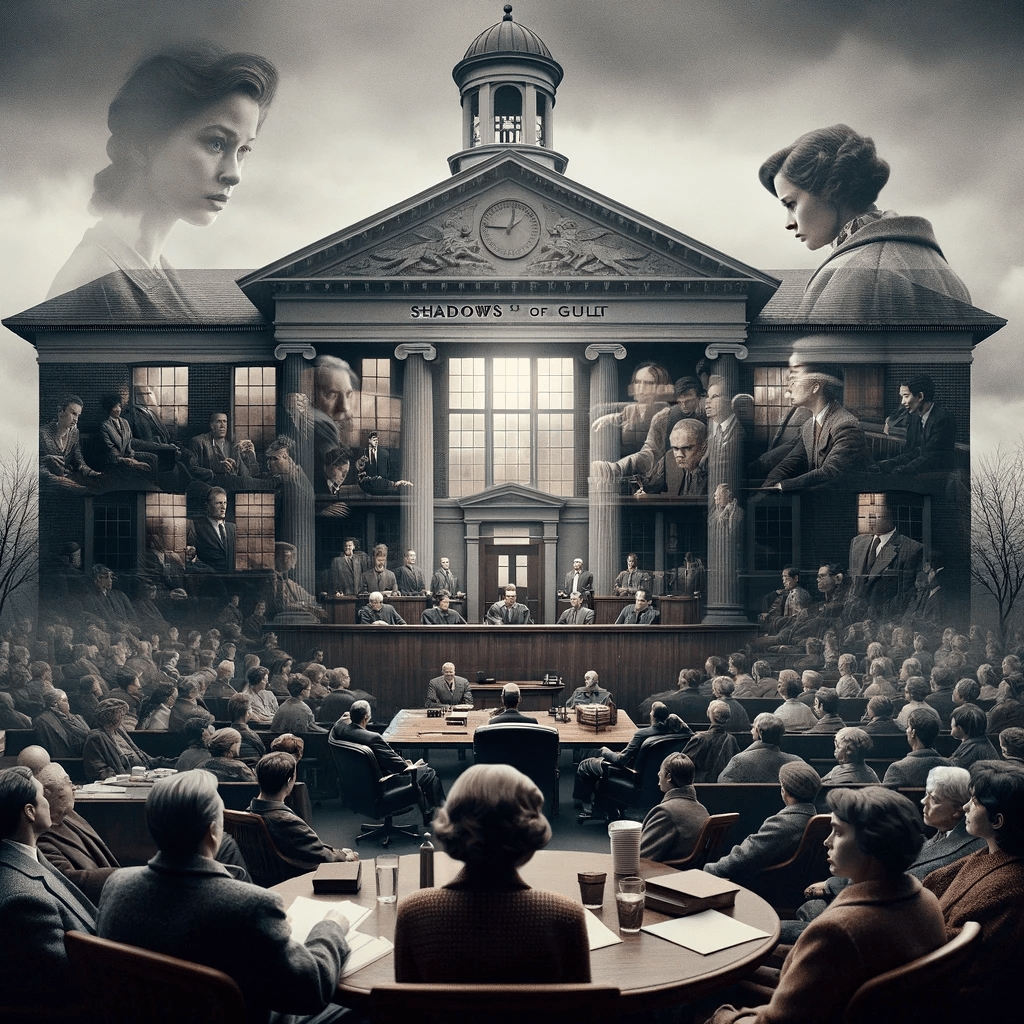
Chapter 7: Verdict in the Shadows-
The final day of the trial dawned with a sense of somber expectancy. Willow Creek, a community once united by grief, now found itself fragmented, its residents torn between empathy and outrage, truth and speculation. The courthouse, a stoic edifice amidst the turmoil, braced for the impending verdict.
Inside, the tension was palpable. Meredith Langley sat, a solitary figure defined by the weight of accusation and the burden of her own conscience. Detective Harrow, off to one side, observed the scene with a complex mix of duty and doubt.
The jury, having deliberated through the night, entered the courtroom. Their faces were unreadable, a collective mask that gave nothing away. As the foreman stood to deliver the verdict, a hush fell over the room. “In the case of the State versus Meredith Langley,” he began, his voice steady, “we find the defendant…”
“Not guilty.”
A collective gasp rippled through the courtroom. The verdict, a shock to many, was a reflection of the ambiguity that had shrouded the case. The lack of definitive evidence, coupled with the revelation of the potential brake defect, had tilted the scales in favor of doubt.
Meredith, upon hearing the verdict, remained motionless, her expression one of stunned disbelief. Relief was absent from her eyes; instead, they held a depth of sorrow and resignation. She had been acquitted by the law, but the trial had not absolved her of her own guilt.
As the courtroom emptied, a cacophony of reactions filled the air. Some expressed outrage, convinced of Meredith’s guilt despite the verdict. Others spoke of justice and the importance of reasonable doubt. The media swarmed, their cameras and microphones capturing the moment, framing it for a world far removed from the reality of Willow Creek’s pain.
Detective Harrow exited the courthouse with a sense of unfinished business. The trial had provided answers, but not closure. The truth, he realized, was a complex entity, often obscured by the shadows of human emotion and bias.
In the days that followed, Meredith found herself living in a liminal space. She was free in the eyes of the law, but imprisoned by her own memories and the ghosts of her past. The spectral visions of her family, once a source of torment, had become her only companions in a world that had turned its back on her.
The community of Willow Creek, too, grappled with the aftermath. The trial had been a catalyst, exposing the undercurrents of judgment and fear that lay beneath the surface of any community. The residents, reflecting on their own reactions to the tragedy, were left to consider the ease with which suspicion could transform into certainty, and the fragile nature of truth in the court of public opinion.
As the seasons changed and life in Willow Creek moved forward, the story of Meredith Langley remained a haunting presence. Her house, once a home filled with love and laughter, stood as a silent testament to the tragedy. It became a symbol of the town’s collective guilt and a reminder of the human capacity for both compassion and cruelty.
Meredith, living in the shadow of the verdict, carried the burden of her actions and the judgments of those around her. The truth of what happened that fateful day remained known only to her and the ghosts that lingered in the corridors of her home. In the end, the trial of Meredith Langley was a journey into the heart of darkness, a journey that left more questions than answers, and a reminder that sometimes, the truth is as elusive as the shadows that dance in the corner of our eyes.

Epilogue: Whispers of Redemption
Years passed, and the tale of Meredith Langley faded into a somber legend within Willow Creek. The house, once a symbol of tragedy, was reclaimed by nature, its walls whispering secrets to the wind. In the town, life moved on, but the echoes of the past lingered in hushed conversations and reflective glances.
Meredith, a specter of her former self, found solace in anonymity, living in the fringes of a world that had once judged her. In her solitude, she penned a memoir, a cathartic journey through guilt and redemption. It was her testament, a final attempt to reconcile with the shadows of her past.
As the pages of her story turned, the ghosts of her family faded into the light, their whispers a bittersweet farewell. In the end, Meredith found a semblance of peace, not in the judgment of others, but in the quiet acceptance of her own flawed humanity.

 Tangents Brand : Free Entertainment, no BS
Leave a comment